This is a photo diary of my costuming "travels"; where I've learned and struggled to make historical costumes for myself. They're not always pretty, but always fun, most of the time. And I want to share with others what I learn along the way. **You can find me on Facebook, https://www.facebook.com/Time-Traveling-in-Costume-640703499399817/ or have my posts delivered to your email by signing up at the lower part of the right column.**


About Me

My photo
HI, my name is Val. I'm a member of Costumer's Guild West in Los Angeles, Dean of 2018 & 2024 Costume College; Past President of the San Diego Costume Guild, and a representative of the San Diego History Center. I also put on historical fashion shows for various groups. I make my own historical costumes but don't sell any unless I get tired of one.The eras I've made so far are 1770 up to 1918. My favorite is the 1880s bustle.

Followers

Showing posts with label One Hundred Years of Mourning Fashion show. Show all posts

Tuesday, August 13, 2013

One Hundred Years of Mourning fashion show at Costume College 2013

August 2, 2013

Also known as “A Murder of Crows”
I have to admit, having a fashion show at a costume convention with 12 people is a bit of a stretch, especially when those people are also attending the convention and some of them are teaching classes. So I was extremely gratified when all but two were very happy to repeat our successful show from the Riverside Dickens Faire, and I was able to find two models who could wear the two gowns that those missing models who were unable to attend so graciously offered. A couple of them even drove up for the day just to be in the show. And this time I invited Nancy and Russell S. from Riverside Dickens to be our narrator and Undertaker/doorman.   
I made up and printed programs for Russell to hand out to the students that had each model listed with the era of their gown so our audience could follow along better. The whole idea is to see a living timeline of the changes in dress silhouette.  I printed them on white paper with this gravestone on half of one side then on the opposite side of the paper printed the information so it could be folded in half. I thought it would be a nice touch to the program.
I also found some background music to play as people entered the room to sit down to create an atmosphere.  It was Beethoven’s Symphony #7 and I found it on itunes for 99 cents. I only wanted the first couple minutes allegretto from the symphony to play because the second half was a little more upbeat, and not quite the mood I wanted. Fortunately I found it was the same music that was used in the movie, “The King’s Speech” with Colin Firth. They did exactly what I wanted in his “Speaking Unto Nations” radio talk. If you want to hear it to get into the mood while you read this, its here on youtube. Speaking Unto Nations-Beethoven's symphony #7  Even though the subject matter of our presentation isn’t the happiest, we had bits of joking and light comedy to lighten the mood so it wasn’t gruesome. My intention was for it to be educational and the dramatic black silhouettes showed the different decades off very clearly.
I can tell you we got a lot of attention when we were walking around and assembling for this. A lot of photos are showing up, and I’ve been waiting for more before I finished this entry.


With the set-up at Costume College (CoCo), we would be doing this in a classroom setting, not a stage this time. That caused me some worry as to how we would be able to line up along a wall for people to see us. We were assigned a room on a corner that had an entrance at the back and on the side. The room was long and slightly narrow so I requested the hotel turn all the chairs sideways to face the long wall. I had the students enter at the back door and we lined up outside the front side door so we could walk in after the music stopped.  Have I mentioned  herding cats before? Trying to figure out who walked in first for the timeline to end up correct along the wall seemed to be mindboggling to us all.


Nancy began reading the introduction to the program and introduced One Hundred Years of Mourning Fashion, and we walked in. For a nice touch, Nancy and Russell had made a black wreath and hung it on the front of the podium. I thought this was a very thoughtful addition, and someone later sent me a pic of mourning drapery. Hmmmm…this could turn into a big production someday.


We had a total of 12 people included in this presentation, when I invited Kristine S. as Queen Victoria (1860), and Nancy as our narrator (who also dressed in black) and Russell as an Undertaker. I think we were very impressive. The audience was able to see us quite close, the first row being about 5 feet away. At the end of the presentation, Nancy surprised me by adding, “As the author Charles Dickens would say, I give you the Founder of the Feast, Valarie LaBore”.
I went up to the podium to thank all my models, and to tell the story behind how this all came about. After being inspired by a smaller version of a timeline silhouette of underpinnings, I talked to Shelley P. about us both doing a few more years of mourning dress at the Riverside Dickens Festival fashion show. I contacted Nancy S., the director & producer of the show and asked if we could include it. With her approval, I began contacting costume friends of mine and over the year each of them researched the year they wanted to make. We all tried for as historically correct as possible.
Then I opened it up to questions from the audience and of course the first question everyone always asks, and it still confuses us, what are the stages of mourning in the dress colors? We found out it isn’t cut and dry because it seemed to vary. First year full mourning was unrelieved dull black. No arguments there. Afterwards, additions of color to collars and cuffs were accepted using white, grey, lavender, & mauve. Third year sometimes included the entire dress being  grey, lavender or mauve. But again, that varied according to who you read. And to confuse matters further, some of the earlier time period gowns in full first year would have white. White was also used when mourning a child, as my 1830s model Gina wore.

Our dresses were variously made from cotton, dotted swiss, a modern crape, brocades, embroidered cottons, silk taffeta, and broadcloth. Some dresses contained lots of detail, others not. Each model wore some jewelry accessory that fit her time period. Finding history on the jewelry was probably the hardest because we just couldn’t find it. Our best research was of photos and catalog photos of the mourning dress of the time periods. I found we could also just use a dress of the period and make it black. I don’t think anyone followed the custom of throwing it into a vat of black dye instead of making one. But it was done in the poorer classes. I own two mourning petticoats that when washed, the dye comes out. I can’t positively ID them as mourning but it would be unusual to have them be black since the Victorians liked to be able to have clean white underpinnings.
As we ended the show, our audience gave us a very appreciative round of applause and commented on how impressed they were with the workmanship of our gowns, and the details they put into them. I was so proud of each of them because they were all very nicely done, and weren’t just plain old black dresses. My final admonition in the presentation was “back then wearing black was also considered fashionable as it is today, so buyers of antique fashions beware: the black gown you are looking at may not be mourning but may in fact be a fashionable little black dress.”
These are photos collected from all my friends who took them of us in the class and afterwards in the hallway. I know there are many many more but I wanted to get this blog entry done now. I’m collecting them all to share in my Pinterest page on mourning too.  https://www.pinterest.com/timetravels/one-hundred-years-of-mourning-fashion/ 

To all my models, April D.(1810), Gina L.(1830), Mary D.(1850), Shelley P.(1860 Civil War), Kristine S.(1860 Queen Victoria), Kathy L.(1870), (Me-1880), Tonya C.(1890), Birda H-N.(1901), Cindy P.(1910 Black Ascot), THANK YOU!  Do you know how totally AWESOME you were?
Thank you Arlene T. and Lisa K-B for the loan of your gowns. They were greatly admired. 

I’d also like to thank Mary J., Jennifer R. of Historical Sewing, Rebecca M., Rebecca R., Evan P., Amy M., and Loralee P-O. for generously sharing their photos with me for my blog and album. In fact ALL of us thank you.


*If you go to Costume College next year, be sure to check out the Costume Gallery because we may be displaying some of our gowns, under the label, “A Murder of Crows”. * 
If you wish to see a video of the Riverside Dickens mourning fashion show, they're here on Youtube. 

Thursday, February 7, 2013

One Hundred Years of Mourning Fashion


February 2-3, 2013
A year ago in 2012 just after the last Riverside (CA) Dickens Festival fashion show, I kept thinking about doing more on mourning dress styles and suggested to our coordinator about doing them the following year. After seeing a presentation at Costume College on Dressing the Silhouette which showed ladies dress from the inside out from 1800-1910, I came up with the idea of doing something similar but expanding on it. I thought a solid black silhouette would make the changing fashions really stand out. And we could include some education on mourning customs.
This is our mourning fashion timeline at Dickens last weekend, starting on the right-  1810-Lisa Klassen-Barnes, 1820- Cat Frazier(absent), 1830- Gina Lovin, 1840- Michele Peoples (worn by Pamela Swank-Yates),  1850- Mary Drobnis (dress by me), 1860- Shelley Peters, 1870- Kathy Loftman (dress by Arlene), 1880- Me, 1890-Tonya Clevenger (absent), 1901- Arlene Terrell, 1910- Cindy Piselli.
I had already been talking to Shelley Peters for the last couple years about us doing a couple more gowns, since she portrays the Widow Peters already. I contacted a couple other ladies who had been in the previous shows and a few others, and asked if any of them would be interested in committing to making a correct mourning gown for a specific time period. I chose the dates of 1810-1910 to give each model a decade to cover. I didn’t have much problem filling most of the spots but gave them all the opportunity to change their dates among themselves, which we did a couple times. They each had to do some research of what was appropriate for the time period, both in the dress style and the mourning customs. Most of the customs were similar with a few variances, like when white was still worn with black in the earlier decades. It would also encompass first and second year mourning if they chose to, and different levels of economy and society. They had a year to play around with their design and construct it. One of them had hers made for her by one of the other models; one wore my 1850s mourning gown, and one gown was worn by another model we brought in at the last minute. We lost a couple ladies to jobs, illness and injuries.
Since my favorite decade is the bustle, I chose 1880, specifically 1886, as my decade.
I already had the skirt made so my focus was on the bodice, bustle overskirt, and hat. I also had a muslin for TV’s 463 French Vest bodice, and used black velvet as the vest insert.  I used my black faux-silk taffeta and purchased a big bag of black velvet covered buttons to close the front of the bodice from Trim 2000Plus in the Garment District.. My first idea for the bodice was to make some pleated trim to go along the edges of the vest but after seeing some saw-tooth trim a friend made, I decided to try my hand at making that. And I failed. Then I remembered I’d purchased some black grosgrain saw-tooth trim from the Garment District in my stash. I had 10 yards so I could use as much as I liked. I basted it down the sides between the velvet insert and the taffeta side panels so it would stay in position when I machine-sewed it.
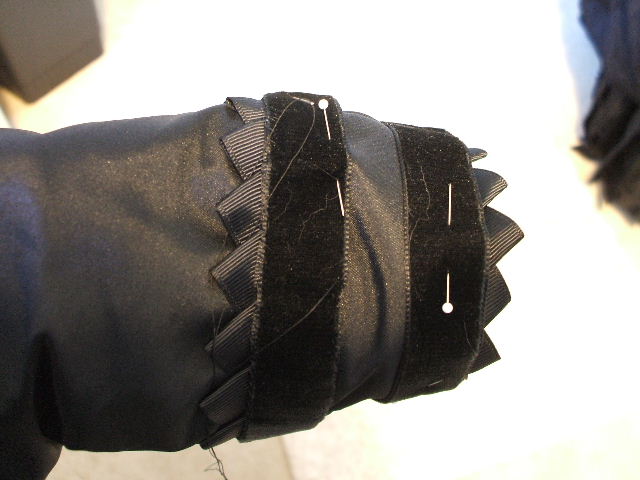
 I repeated the saw-tooth trim with two rows on the sleeves with one row under the sleeve edge, and another about 4 inches up from the edge. I finished the top of both with a one inch wide velvet ribbon that I slipstitched on. I used four of the velvet covered buttons and sewed those evenly between the two bands. Once I put the collar on, I hand-stitched some more velvet ribbon around it.


The pattern for the overskirt, TV 374 is an asymmetrical and splits open on the side front. It has three different types of pleats on it with pleats on one side that drape across the front to the other side, and a group of pleats above it on that side seam. This photo shows the front pleats to the side but got a little wrinkled being carried to the fashion show.


Then a group of burnoose pleats in the back create the bustle. Burnoose pleats are like a hood on a coat that creates a poof. I think. I tried doing them three times before I got them to poof. I still don’t think they’re right but they seem to work. Although I noticed in one photo one of them had turned the wrong way and just looked like a point. But they really are cute little poofs. This photo shows them gathered together, and where the white pin heads are were attached to the waistband after they’re turned inside out to poof.
 On the side opening of the front, I sewed more of the saw-tooth trim all the way down both sides and partly under the bottoms until they didn’t show. The fabric curves under there so you wouldn’t see it anyhow.

 My accessories were a postman-style hat my friend Cat Frazier made for me from scratch, using buckram covered with taffeta and trimmed with a black feather, ribbon, and a black glass round brooch I’d found for 25 cents. She also made me a taffeta and velvet drawstring bag to go with it. I stitched a black ribbon to the edges of a white linen hankie, and wore black cotton gloves. My mourning brooch was an antique jet oval I bought on ebay from Norway; in fact from the town my grandmother came from. It has a small window in the back to hold a lock of hair.  I bought the reproduction earrings from a shop at the San Francisco Dickens Faire last December.


 Here are some candid photos of me while walking in the Characters Parade after the show on the streets.


Prior to our coming onto the stage, our coordinator, Nancy Smith, invited me out to introduce me. This sent a few tingles down my back hearing it. Good ones.
“ONE OF THE THINGS I TRULY ENJOY ABOUT BEING INVOLVED IN THE HISTORICAL COSTUMING SCENE IN SOUTHERN CALIFORNIA IS THE OPPORTUNITY TO MEET SO MANY TALENTED LADIES. VAL IS DEFINITELY IN THAT CATEGORY. SHE IS A PAST PRESIDENT OF THE SAN DIEGO COSTUME GUILD AND A MEMBER OF COSTUMER’S GUILD WEST. SHE HAS DONE PRESENTATIONS AT MUSEUMS AND AT COSTUME COLLEGE, MOST RECENTLY BEING HER TALK ON AMELIA BLOOMER AND REFORM IN WOMEN’S DRESS. SHE HAD ASKED ME LAST YEAR IF I WANTED TO DO A SEGMENT ON MOURNING FOR THIS YEAR’S FASHION SHOW, AND HAS BEEN PREPARING FOR THIS FOR MONTHS. I AM THRILLED AND HONORED TO BRING TO YOU ONE HUNDRED YEARS OF MOURNING FASHION.”  ***********************
For photos I took backstage of the fashion show while we were getting ready, please go to my album here. 
http://www.pbase.com/cinnamonhrts/riverside_dickens_festival_2013

My thanks to all the ladies for their hard work and to photographers Brendan Conoboy, Russ Loftman, and Jerry Abuan for these lovely photos. For more photos, please visit Jerry’s gallery .http://jerryabuan.zenfolio.com/p793860954

We found this link to the Riverside News online, and I'm in the first photo on the left while we were out on the streets. http://www.pe.com/photos/photos-news/20130202-riverside-20th-annual-dickens-festival.ece