This is a photo diary of my costuming "travels"; where I've learned and struggled to make historical costumes for myself. They're not always pretty, but always fun, most of the time. And I want to share with others what I learn along the way. **You can find me on Facebook, https://www.facebook.com/Time-Traveling-in-Costume-640703499399817/ or have my posts delivered to your email by signing up at the lower part of the right column.**


About Me

My photo
HI, my name is Val. I'm a member of Costumer's Guild West in Los Angeles, Dean of 2018 & 2024 Costume College; Past President of the San Diego Costume Guild, and a representative of the San Diego History Center. I also put on historical fashion shows for various groups. I make my own historical costumes but don't sell any unless I get tired of one.The eras I've made so far are 1770 up to 1918. My favorite is the 1880s bustle.

Followers

Thursday, March 3, 2022

MY FIRST OUTING OF THE YEAR; RIVERSIDE DICKENS FASHION SHOW

Last weekend felt like a breath of fresh air. We had our first costume outing of 2022, a fashion show at the Riverside (CA) Dickens Festival, which hadn’t been held in person for two years. As seen in my last post, I made an 1838 dark purple dress for this event. It was partially sewn so when I made the decision of what to wear, it was the easiest choice. The hard part was matching the theme for this year’s fashion show, “The Sun Never Sets on the British Empire”. We were supposed to come up with something that reflected different European influences on Victorian clothes and fabrics. When I looked at the designs on my purple fabric, my first thought was Persian. But the more I thought about it, the less that worked. It actually looked more like trellises in a garden. So, I had to be creative. I stretched it to more printed cottons coming from India, and named it the Indian Gardens. Heh, it worked. And I'd been wanting to make this dress for years. 

As I continued thinking about my accessories, I was also going to include a day cap made of some cotton voile that I had bought from India. But when I dug through my stash, I didn’t have any wide enough left to cut out my pattern pieces on the bias. Even my locally bought voiles were just mere scraps. But this cap is still on my project list. I recently bought a couple yards of a really fine voile from Renaissance Fabrics.  

What I ended up doing instead was to just wear my wig with my black ribbon hair loops pinned in them. I didn’t plan on walking outside in my dress, so I thought this would be fine. I already have one bonnet I can wear with it in the future but probably without the black ribbons.


My other planned accessory, which no one would have seen, was a pleated “bustle” to go under the back of my skirt to give it more roundness. However, I ended up with no time to make that, and just used my previous quilted cheater petticoat, topped with a multi-tiered petticoat to smooth out the top. It gave me a nice round fullness. I still plan to make one at some point, especially since it seemed so easy, and I have the twill denim fabric for it.

I had decided to make myself a pouch-shaped reticule out of the same dark purple silk taffeta that I’d made my belt from, and use a vintage crewel needle sample I’d bought years ago. I used the reticule pattern from La Mode Bagatelle’s Regency Wardrobe, and planned to stitch a dark purple braid around the edges of the needlework, but my local JoAnn’s store had absolutely nothing I could use. And I totally forgot to find some ribbon to do the drawstrings. Again, I had no time to find something online and have it shipped. So, for the time being, I had to settle for a plain black narrow braid, and basted it on so I can remove and replace it later when I find something better. I decided to wear it hanging from my belt, like this fashion plate.


Another accessory I was making awhile back was a cotton pelerine/collar but after finishing it, it seemed too large & heavy for my dress. Back to the drawing board. So at this point, I was considering using one of my other lace ones I had.

But what ended up making my outfit complete was a pelerine I bought from an etsy seller in England. It had the right shape for this time period that was perfect for my dress. I found photos of extant ones with a similar shape, and listed in my book of “White-embroidered costume accessories; the 1790s-1840s”, by Heather Toomer.  

These are from the Tasha Tudor Collection (sold by Augusta Auctions) and some others held in the V&A Museum.


From the moment I draped the pelerine over my dress, my mind just blew up with joy. It made my dress! With the help of a friend, she was able to identify the lace style as Belgian net lace with muslin appliques. This was perfect, because it gave me another tie-in to the European influence we wanted for our theme. This ended up as a Valentine’s gift from my hubby.


With everything ready to go, I was able to relax a bit, but two days before our show, I slipped off the side of a small ottoman stool, and landed on the side of my knee, which already has its issues from being injured. It caused my knee to swell up and I could barely walk. After a day of icing, heating, elevating it, and a good night’s sleep, the swelling went down enough so I could bend my knee and walk on it without too much pain. But it did limit my walking. Cindy & my plans for the day at Dickens was to show up, do the show, change out, and then stroll a couple antique shops in town, before heading home. We were both going through withdrawals of antique shopping after two years.

The fashion show was in a new location this year, in the Life Arts Building, two blocks away from the main festival. It was a large nicely lit room from lots of windows, and the stage was only one step up, thank goodness. But I even needed help stepping up and down from that.

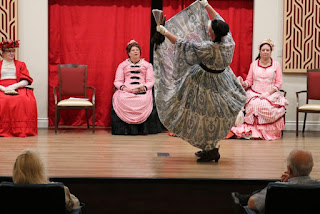
All the models were seated in a chronological line-up off to the side, and I was first one up with my early dress. After I had done my twirl, and returned to my seat, I pulled out my camera and started taking photos of the other models. Of course I hadn’t been fast enough to think of handing it to someone to take one of me. But I found a couple that someone else had taken.


Afterwards when we all went on-stage for group photos and letting people come up for closer looks, I handed my camera to Laurel, our stage director, who took photos of us, and a couple by someone in the audience. Our Queen Victoria, Janet Clark, came up to stage first to thank us all for attending this year, and complimented each of us. I had one lady tell me she had been hesitant on making an 1830s dress herself, as she thought the sleeves would look strange, and had no idea how to keep them puffy. After seeing mine, and how I explained different methods to work with them, I think she’s now confident to give it a shot. I love it when you can help inspire others.


You know what this means now, don’t you? Time to pull out all those dresses I started and finish them up. We’re baaaaack!

Next up, the fashion show in Port Townsend, WA, for the Victorian Festival on April 30.


Tuesday, January 11, 2022

THE INDIAN GARDENS 1838 DRESS

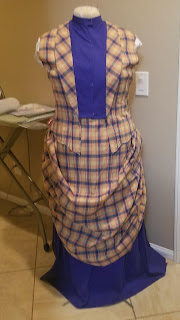
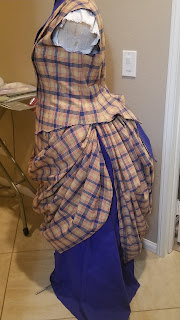
 My blog last year was very sad. Only three posts for an entire year. But there was barely anything worth writing about. I played around with a couple dresses but didn’t finish anything. Yes, a couple are very close, and I wrote about one in my blog (1887 Autumn Plaid bustle dress)) but to date, none are finished.
Last week I was contacted by one of our fashion show organizers updating us on the status of the Riverside (CA) Dickens Festival, and this year’s theme, so it made me start thinking hard of what I wanted to wear for it. I had a few ideas for new dresses, but really? Did I think I would get it together enough to start and finish a NEW dress by the end of October? Not the way my life has been going. I took a look at what was in progress and decided to picked one from there.

About 5 months ago I tried to get my sewing mojo back in gear. I spent days looking through dresses from my inspiration file, and then cross-referenced my fabrics, all while trying to get a spark going. Something finally kicked in with the 1830s fabrics I’d collected, and boy, did I have a lot of different fabrics for that! I have cottons, I have silk taffetas, I have plaids! Plaids have been hard to find lately, at a reasonable price, so I’d been grabbing any that struck a cord, and were a good price. I still consider this a hobby and a costume, so I don’t throw a lot of money into it unless I have too. These are my pretty fabrics. 


Rather than make yet another Truly Victorian pattern for this period (of which I’ve made 5 from it), I looked at two other ones I had. And this time I wanted to convert the pattern to a front opening. I’d seen it done by a friend at Costume College and you could barely tell it opened there, which is what I was hoping for. I also wanted one that wasn’t off the shoulders. I had Period Impressions 1837 Day Dress pattern that I’d seen made up by another friend, Carolyn, and it was lovely, but she said it was very hard to work with. The Past Patterns #003 1830-36 Full High Gown was the one I chose, which was also the one another of my friends, Cindy, had made up and she said it wasn’t hard to make.


I didn’t have much luck in trying to find some extant examples of the ones not off the shoulders; most of what I found weren’t. I also read front closures were more likely for work dresses, like this brown one.


But I had an idea of putting a decorative placket down the front to help conceal that.

Since this was going to be a test pattern, and also the silk taffetas were a little fancy for a closed neckline day dress, I decided to start with one of the cottons. The purple cotton was my favorite, and I also had that fabric the longest, so it had plenty of time to age properly. Last August I cut out my muslin and roughly fitted it, knowing it would have to be fitted on me with the gathers at the shoulders down to the waist. I cut out the purple bodice pieces, flatlined it, and sewed it together. Later I sewed the skirt and sleeves, and set them aside. That was as far as I got, because I couldn’t go farther without the bodice being fitted.  

Jumping forward to last week with the Dickens Festival, and I started thinking about this dress again. It had some aspects that would fit with the Festival’s fashion show theme and it was slightly close to being done. And then I came across another version of a work dress that Past Patterns had done in the meantime, converting it to a front closure, #017.  If I had known this pattern was out there, I would have bought that and saved myself a lot of work converting #003 to a front opening. Today I bought it for myself as a late Xmas present, and I may use that for my other fabrics in the future. https://www.pastpatterns.com/1830s-to-1840s-jacksonian-era/workdress-with-three-sleeves-pattern 

And then I remembered one of the dresses from my very favorite series, Cranford, and Return to Cranford. This was the series that started me on my love of 1830s.  The dress Imelda Staunton wears numerous times was BUTTONED DOWN THE FRONT. And just look at those magnificent sleeves of hers! This certainly didn’t look like a “work dress” the way she accessorized it up.


I also made a note of her belt, and saved this photo of a red plaid dress from another exhibit I saw. I think a black belt on mine would look good. It was also plaid so a two-fer.

Since I still didn’t have anyone to fit the pleating on the front of my bodice on me, I pulled out the skirt, which I’d forgotten I’d already sewn the side seams, and this made it quicker), and began to cartridge pleat it. I got to use my new package of Tiger Tape I’d bought recently for this. I heard about it from another costumer, and its pre-marked for the ¼” that we use for pleating. You can use any width you like. Its slightly sticky but I found mine didn’t stick very well and used some pins to keep it in place. Others said they had no problem with it sticking, so maybe mine is a bit dry, or its my cotton fabric. I bought it on Amazon but quilt stores carry it. I don’t know about fabric stores. Because my eyes made the tape markings a bit blurry, I marked every other line w/ a dot of black felt marker to make it stand out more so I wouldn’t miss a stitch. I used one 18” piece I cut for the entire skirt. The roll comes with 30 yards.


My sleeves also were sewn together and I plan to baste those in today. I pinned my skirt onto my dress form to see how it looked. The pattern called for 4 panels of 45” wide fabric for the skirt but I only had enough fabric to cut 3 panels for it. I think it will be fine.

The end of this week Shelley Peters is holding a sewing workshop again, so I’ve decided to go up on Friday and ask her to fit my bodice for me. I may get this done by this weekend! Since I like to name my dresses to remember them, I think this one will be Indian Gardens.

While I was reading all the information in the Past Patterns booklet, I kept looking at the paper doll drawings she’d included of all the underpinnings. One thing stood out to me, a stiff ruffled “bustle” on the back of the petticoat.


I know they wore corded petticoats under their skirts at this time, and I’ve also used a cheater one using a quilted fabric that I pleated the waist to hold it out. But it didn’t have the fullness up at the waist that they had. I wasn’t sure about the accuracy of this “bustle” because I assumed they’re were from the much later bustle period. So, I asked on a Facebook group, 1730-1830 Clothing Construction Support Group for any insight. They confirmed that this was authentic, and was documented in the 1838 version of The Workwomen’s Guide, with description and diagrams.

I first wanted to try and buy one already made since I didn’t want to start yet another project, but had no luck. However, after talking to those ladies, and seeing how easy it is to make, and also happen to have quite a few yards of a denim twill in my stash, I’ve decided I’m going to give this a try. This is one that one of the ladies there made. There is also a similar one in the American Textile History Museum, in Lowell, Mass.

To further assist me, there is also a video on the American Duchess Youtube page showing how one is made. 
https://www.youtube.com/watch?v=iGYZTiQWFXY&list=PLqq0sGYvo3WKbTsM5e1YzMrwbSc0NmSze&index=8 

I need to get the twill fabric down off of one of my closet shelves so I can start it, but I don’t know why that seems so hard to do these days. Baby steps, girl, baby steps.

Saturday, December 11, 2021

IDEAS FOR A COSTUME VENUE


We all know costuming events have been a desert out there for the past two years. And I’d guess that most of us are still in a costume sewing slump too. I’ve continued with my “baby steps” sewing my costumes, or a better description, “bits & pieces”. Right now, I have four different dresses in various stages of construction that get worked on when the mood or energy strikes me, which is mostly about a day.


A while back I had recognized that this was becoming a pattern with me; I’d go full-on enthusiasm to start a new dress, and after a short time it would fizzle away. And then another dress would be started, and same thing would happen. I’d put it aside as I had nowhere to wear it so what’s the rush? But eventually one of them would get done, or at least closer to being done. I decided that if this was how I worked, so be it. Don’t fight it. When an event comes up for it, you can be that mad crazy lady again.

Towards the end of the year, things began to loosen up from (need I say it?) Covid isolation, and a few events cautiously started up. There was a dim light in the tunnel, inviting us to come out again. There was hope. 

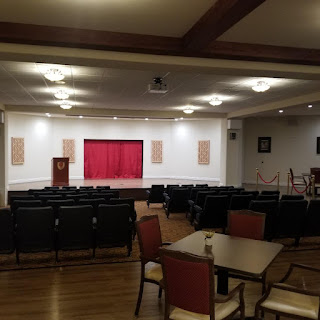
In September, I had helped my mom move into a retirement community and noticed they had a beautiful indoor dinner theatre with a stage, great lighting, and lots of seating.


It reminded me that a few years ago I’d seriously begun to plan on offering historical fashion shows to retirement communities, and had even participated in two that my friend, Cindy, put on. Today I had a Memory pop up on Facebook that showed I was already thinking about this 9 years ago, in 2012. A few years ago, there was a really nice location down the street from where I lived. But then we moved away. And now here was a brand-new location only ten minutes away from where we moved to, and I had a connection to approach them about doing it. I had already designed a flyer that had photos of previous fashion shows I’d put on or worked on that I could hand out. I sent an email to the Activities Director at the community, and got an enthusiastic response back.

She had the next two months, November and December, open for activities, and after polling the ladies in my pool of models, we decided on November 6. Over the years I’ve done a variety of themes for my shows, even having stage settings like a grand parlor, or an atelier’s dress shop. But for a first-time event I usually do a timeline. It’s the easiest to work with and gives the models of variety of periods to work with, depending on what they have available. The hardest part is making sure we have a good variety of time periods to fill in the timeline.

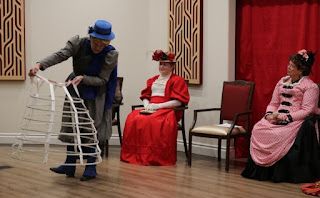
Most of the fashion shows I’ve been in have had other costumers in the audience, and many of them know the time periods or the differences. With a senior community, you can’t expect this. So, I lean towards making them educational, along with being pretty and entertaining. We’ve found that most audiences are really interested in what’s going on underneath our gowns, in other words, what makes the shapes. Occasionally, if you have time, you can have a model that’s willing to be dressed from the inside out. But in these, our time is shorter, and I like to have examples of the corset, hoops, and bustles to hold up and show them how they work. You also wouldn’t want to shock the audience if they’re not used to them. 

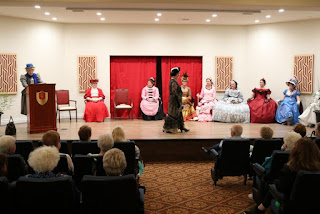
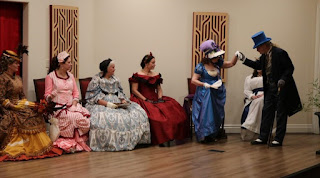
For this show I tried something different, rather than have the models come out one at a time. We were all seated onstage, and then called on to come forward. I thought this would make it easier for us, and also give the audience more time to see us after we’d done our “twirl” on stage. We even have a gentleman who participates, and gives us a hand up.  


Here Shelley is not showing off her undies, but showing how sheer her cotton voile dress is for summer wear. 

After the show we stepped off the stage and walked among the audience members so they could look at our dresses close up and ask questions, which they did! That also gives me ideas of things to include in the narratives of future shows. And there will be future ones. They were all asking when we would come back so they could invite their friends. The Activities Director gave us the green light for that. We also were asked about two other locations that we might do this in, so we have that to look forward to in the coming year. We were all just so happy to be able to dress up and show off our "works of art" again. 

I’m hoping after the holidays are over, the mood might come over me again to finish up all those other dresses.